KM3TPI - Tree-based Particle Identification
The module being developed to become KM3NeT's standard data-processing and machine-learning pipeline - converting ROOT/DST files into ML-ready Parquet datasets and training XGBoost-based particle identification classifiers, for use on a computing cluster or locally.
Overview
km3tpi (KM3NeT Tree-based Particle Identification) is a single-repo toolkit being developed as the standard module for processing KM3NeT neutrino telescope data and training machine-learning classifiers on top of it. It converts ROOT-based DST files into chunked Parquet datasets and ships an XGBoost-based ML layer (Optuna tuning, MLflow tracking, sklearn-pipeline serialization) that consumes those datasets directly, with no re-reading of ROOT files. It is built to run identically in both target environments - interactively on a laptop (notebooks, prototyping, small subsets) and at scale on a computing cluster (Snakemake with SLURM/HTCondor profiles, CC-IN2P3-scale production) - so the same codebase serves day-to-day development and full mass-production runs.
Idea Board
The project was scoped around one guiding principle: one repo to rule them all, covering both data conversion and machine learning.
- One repo for all
- Data converter
- Machine learning
- Agnostic approach - robust to upstream changes (branch names, detector configuration, ROOT schema)
- Modular design (
km3tpimodule)-
preprocesssubpackage -
mlsubpackage
-
- Snakemake compatible
- Project organized by dedicated maintainer
- User friendly for task delegation
- Environment handling
- Conda
- Singularity/Apptainer
- Testing & CI/CD
Physics Motivation
The neutrino mass ordering (NMO) signature lives in the difference between track-like and shower-like events. Better event classification means tighter NMO constraints. km3tpi’s classifier tasks follow directly from this:
- Neutrino vs. muon: separate atmospheric neutrinos from the much larger atmospheric muon flux.
- Track vs. shower: identify interaction topology in the absence of direct flavor identification.
- Event vs. noise: discriminate real events from natural background noise.
Containment/fiducial-volume tagging is identified as a natural future extension within the same architecture.
Input Files
- DST ROOT files: KM3NeT offline files organized by detector run, containing
EandTtrees.-
Etree: event-level reconstruction and MC truth (tracks, energy, direction, hits). -
Ttree: trigger-level summary quantities (nhits, atot, gandalf features, fit results).
-
- Sample types:
data,nu_mc,mu_mc,noise_mc. - Alias schemas are auto-discovered per
(sample, tree)rather than hardcoded, so the pipeline tolerates upstream branch changes.
Pipeline Architecture
km3tpi is organized as two Snakemake-compatible layers inside one modular package: km3tpi.preprocess and km3tpi.ml. The output of the first layer (canonical Parquet chunks + manifest/metadata JSON) is exactly the input contract of the second, so the two run as one connected DAG.
Preprocessing Layer (km3tpi.preprocess)
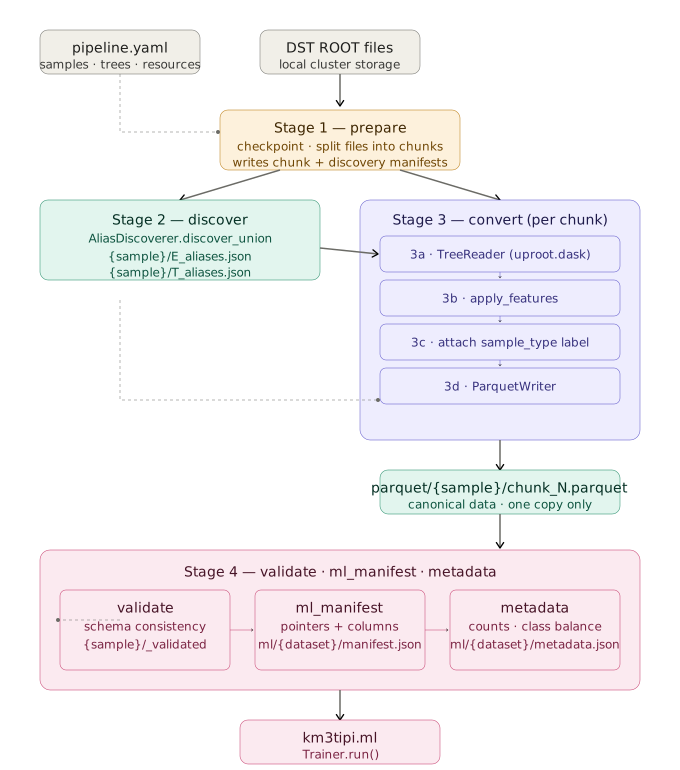
- Prepare - checkpoint stage; splits input files into chunks and writes chunk + discovery manifests.
- Discover - scans a sample of files to identify populated branches and writes alias JSON schemas per tree (
{sample}/E_aliases.json,{sample}/T_aliases.json). - Convert (per chunk) - one fused, lazy dask-awkward graph: read (
TreeReader/uproot.dask) →apply_features→ attachsample_typelabel →ParquetWriter. Only branches listed in the alias JSON ever touch disk. - Validate - checks schema consistency across all chunks of a sample, emitting a
_validatedsentinel. - ML Manifest & Metadata - lightweight JSON manifests (
ml/{dataset}/manifest.json,ml/{dataset}/metadata.json) pointing to chunk directories - no data duplication, pointers + column lists, event counts, and class balance only.
The canonical Parquet output (parquet/{sample}/chunk_N.parquet) is a single copy that both feeds into stages 4–5 and is the only data the ML layer ever reads.
Machine Learning Layer (km3tpi.ml)
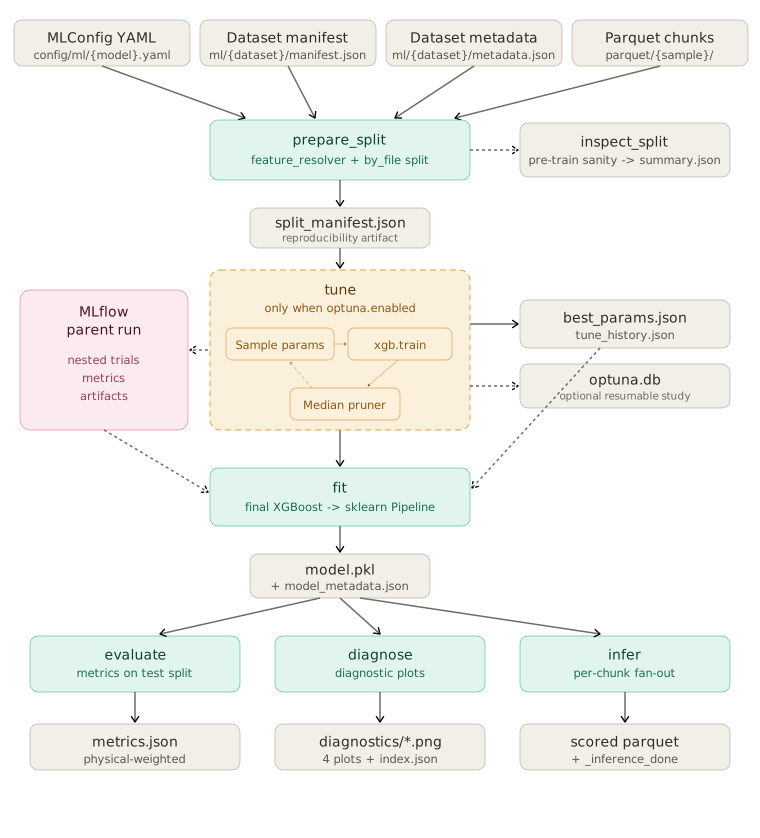
Built around a two-tier archetype: Trainer (owns tuning/fitting, usable standalone) orchestrated by MLProcessor (mirrors the preprocessing DSTProcessor; owns dataset loading, MLflow context, evaluation, saving, and diagnostics). Four inputs feed the DAG: the per-model MLConfig YAML, the dataset manifest, the dataset metadata, and the Parquet chunks themselves.
- Prepare Split - resolves features against dataset metadata and assigns a by-file train/val/test split, writing
split_manifest.jsonas the reproducibility artifact. - Inspect Split (side branch) - pre-training sanity check (class counts, feature correlations, missingness) summarized to
summary.json. - Tune (conditional) - only enters the DAG when
optuna.enabled; samples params, callsxgb.train, prunes with a median pruner, and writesbest_params.json+tune_history.json(optionally a resumableoptuna.db). - Fit - final XGBoost training wrapped in an sklearn
Pipeline, using inverse-frequency class weights for balancing (physicalweight_one_yearlivetime weights are carried as a column for evaluation only, never passed to the training objective). Writesmodel.pkl+model_metadata.json. - Three downstream consumers read the fitted model and test split in parallel:
- Evaluate - metrics (accuracy, ROC-AUC, log loss) →
metrics.json. - Diagnose - four diagnostic plots (score histogram, ROC curve, confusion matrix, feature importance) →
diagnostics/*.png+index.json. - Infer - per-chunk fan-out scoring → scored Parquet (and, on the ML pipeline branch, a lightweight ROOT score tree for downstream compatibility).
- Evaluate - metrics (accuracy, ROC-AUC, log loss) →
An MLflow parent run cross-cuts tune and fit for tracking (nested trials, metrics, artifacts).
Output
- Preprocessing: one canonical Parquet file per chunk, never duplicated; ML datasets reference these via manifest/metadata JSON.
- Machine Learning: trained model (
model.pkl+model_metadata.json), evaluation metrics, diagnostic plots, and scored Parquet/ROOT outputs for inference. - Full run history and metrics are tracked in MLflow; hyperparameter search history is optionally persisted in a resumable Optuna study database.
Key Features
- The future data + ML module: intended as the standard toolkit for KM3NeT data processing and classifier training going forward, not a one-off script - designed to be picked up, extended, and delegated across the collaboration.
- Cluster-first, laptop-friendly: the same Snakemake DAG runs locally for development on small subsets and scales to full production on SLURM/HTCondor, with no code changes between the two.
- One repo, two responsibilities: data conversion and machine learning live in a single, modular
km3tpipackage (preprocessandmlsubpackages). - Agnostic by design: alias discovery and schema validation make the pipeline robust to upstream ROOT branch changes and detector configuration (ORCA/ARCA).
- Environment handling: Conda for development, with an Apptainer/Singularity container planned for full cluster portability.
- Testing & CI/CD: fast unit test suite (currently 83 tests, sub-2s wall time) plus demo notebooks (
demo_processing.ipynb,demo_ml.ipynb) for interactive walkthroughs. - User-friendly task delegation: single source-of-truth YAML configuration (
pipeline.yaml+ per-modelconfig/ml/{model}.yaml), Sphinx documentation, and a monitor view for pipeline status.
Status & Roadmap
Preprocessing module, preprocessing pipeline rules, ML module, ML pipeline rules, documentation, environment versioning, and CI/CD (71% coverage) are complete for v1. Active next steps: Singularity container for full cluster compatibility, continued pipeline testing at production scale, and feature engineering/cut selection.
Long-term objectives: a baseline track-vs-shower classifier on νμ-CC / νe-CC samples, a first end-to-end run on full ORCA MC production, checking extension to ARCA, integration into existing collaboration workflows, dedicated MLflow monitoring, first official checks against ORCA23/24 mass production, and extensive documentation for members delegating tasks who are less familiar with Snakemake.